Global Entry
- 4.9
- Rating
- 500.00K
- Installs
- Free
- Price

 Analysis by App-foxy
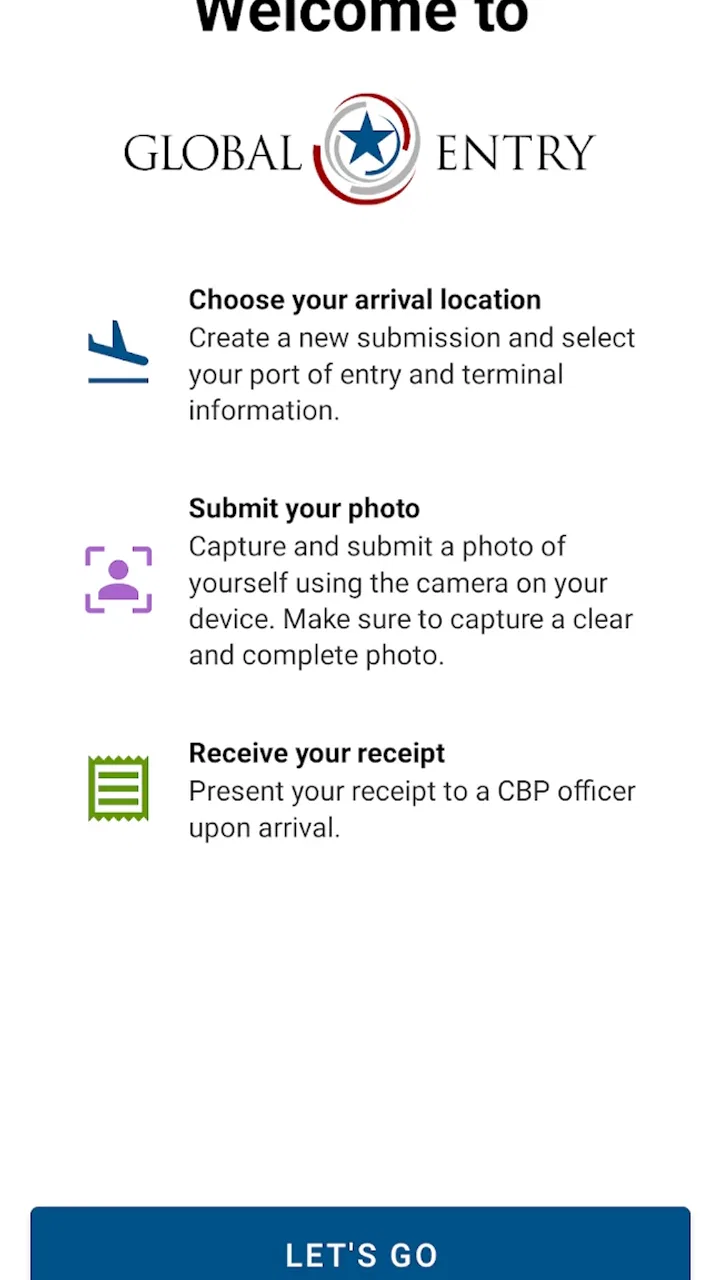
For travelers who already have Global Entry membership, this free Travel & Local app from U.S. Customs and Border Protection is designed around one focused task: reporting arrival at supported airports. I see it less as a general travel companion and more as a practical checkpoint tool. That narrow purpose is important when deciding whether it deserves space on your phone, because its value depends almost entirely on your travel status, destination, and willingness to use an official government service instead of a broader airport app.
In my experience, the best way to judge Global Entry is not by asking whether it has lots of travel features. It does not need to compete with itinerary planners, airline apps, airport maps, or mobile passport tools on their own terms. The useful question is whether it makes the arrival-reporting part of an eligible trip easier and more direct. For an enrolled member traveling through a supported airport, that can be a meaningful advantage. For everyone else, the app may have little practical purpose.
How I would decide whether Global Entry fits
The first decision point is eligibility. The app is specifically for Global Entry members, so downloading it does not replace enrollment, approval, or membership. If you are researching the program rather than already using it, the app should not be mistaken for an application portal or a general explanation of border procedures. Its role begins when a member needs to report an arrival through an airport where the service is supported.
You May Also Like

 Blood Strike: 2.5 Anniversary
Blood Strike’s Loadouts Turn Every Drop Into a Tactical Gamble
A close look at Blood Strike’s custom loadouts: how fast access to signature weapons reshapes its battle royale rhythm, rewards preparation, and narrows the gap between fights.

 Pandora - Music & Podcasts
Pandora’s Music Is Easy to Start, but Harder to Recover
Pandora’s strength is its low-effort path from a seed to a station. Its weak spot is how much confidence it asks you to place in connection, setup, and quiet recovery.

 8 Ball Pool
 Is Built on Rivalries, Rematches, and Routine
A close look at the rivalries, rematches, shared routines, and unanswered safety questions that turn a quick pool match into a persistent mobile community.

 Samsung Music
’s Quiet Strength Is Playing What You Already Own
Its reach comes less from spectacle than from dependable access to a personal library. That simplicity is both the app’s strongest retention engine and its ceiling.

 AccuWeather: Weather Radar
AccuWeather Review: A Quick, Clear Forecast for Everyday Decisions
For everyday plans, the best forecast is the one you can understand quickly. AccuWeather makes rain timing, radar, and local conditions easy to act on, with a few trade-offs.

 Hill Climb Racing
Why Hill Climb Racing Still Turns Crashes Into One More Run
A tiny car, a bumpy hill and one more upgrade: Hill Climb Racing keeps resurfacing because its simple chaos makes every near-miss feel personal.
More From Our News Desk



The second decision point is the airport. “Supported airports” is not a detail I would treat casually. A traveler can have an eligible membership and still need to rely on the usual process if the particular airport or arrival situation does not support the app’s workflow. I would check the current airport availability before traveling, rather than assuming that every international arrival will work the same way.
The third question is what kind of convenience you actually want. If your goal is to organize flights, store boarding passes, monitor delays, or find airport facilities, an airline app or a dedicated airport app will usually be a better match. If your goal is specifically to handle an arrival report connected with Global Entry, this app is more relevant than those broader tools because it is built around that one government service.
There is also a trust consideration. The developer is U.S. Customs and Border Protection, which makes the app a natural choice for people who prefer to use the official source for a government-linked arrival process. That does not mean the experience will always feel as polished or flexible as a commercial travel app. It does mean the app’s identity is clear, and I would personally rather use the official application for this particular task than depend on an unofficial imitation.
What the focused design gets right
The strongest quality here is focus. Many travel apps try to do everything, which can leave important actions buried among bookings, recommendations, notifications, and promotional content. This app has a much narrower job. When I am returning from a trip and thinking about the next step at the airport, a focused tool is easier to understand than a crowded travel dashboard.
That focus also makes the app easier to evaluate before a trip. I would install it while I still have reliable internet, sign in or prepare the required account access ahead of time, and review the arrival workflow before standing in a busy terminal. This is a small but useful habit: the best time to discover an access problem is at home, not after a long flight when attention, battery, and patience are limited.
A second strength is that it brings the arrival-reporting action onto a phone rather than requiring the traveler to remember a separate process at the last moment. I would not describe that as a replacement for every airport procedure. Instead, I see it as a way to make the member’s part of the process more accessible when the airport supports it.
The app is also free, which removes an obvious barrier to trying it. It has an Everyone content rating, and the current release is version 2.1.2. It supports Android from version 8.0 onward, so people with older devices should check compatibility before building their travel routine around it. Those details matter more here than they might with a casual app, since a traveler does not want to discover a device limitation immediately before departure.
Its public reception is strong: the app shows a 4.9 average from around 11 thousand ratings, with more than 500 thousand installs and 434 written reviews. I would treat those figures as encouraging rather than as a guarantee. A high average suggests that many users find the core experience useful, but travel apps are highly dependent on airport support, account status, connectivity, and the exact circumstances of a trip. A smooth experience for one member may not translate perfectly to another airport.
A realistic arrival scenario
Imagine I am returning to the United States after several days abroad. Before leaving for the airport, I open the app at home, make sure I can access my account, and confirm that my destination is among the supported airports. During the journey, I keep my phone charged and avoid assuming that the airport’s network will solve every connectivity problem. After landing, I use the app when the arrival process calls for it, then follow the airport’s instructions rather than treating the phone screen as the only step that matters.
That last point is important. A mobile arrival report can reduce friction, but it does not turn border processing into a completely self-contained phone transaction. The app should be viewed as one part of the airport workflow. If staff, signage, or the airport’s process directs me elsewhere, I would follow those instructions. The practical benefit is not that the app eliminates every interaction; it is that it can make the member’s reporting step more convenient in the situations it supports.
For frequent international travelers, the value becomes easier to see. A person who repeatedly returns through supported airports may appreciate having the same official tool ready each time. For someone taking one occasional trip, the benefit may be smaller, especially if the traveler is already comfortable with the standard Global Entry process. That is a genuine trade-off: the app is most compelling for repeat use, not because it offers a large collection of unrelated features.
Three habits that make the app more useful
My first practical tip is to separate “installed” from “ready.” Installing the app at the airport is not preparation. I would open it before traveling, confirm that the account access works, and make sure the phone has enough battery for the arrival period. I would also keep the usual travel documents available, because a digital tool should support the trip rather than become the only thing I depend on.
My second tip is to verify the airport for each relevant itinerary instead of relying on memory. A traveler may use one airport frequently and assume another airport offers the same workflow. Since support is tied to particular airports, checking the destination before departure prevents an avoidable surprise. This is especially useful on itineraries with connections, where the airport associated with the arrival process may not be the airport a traveler first thinks about.
My third tip is to treat the app as an arrival tool, not a trip-management tool. I would not expect it to replace my airline’s application for flight changes or boarding information, and I would not use it as a substitute for an airport map. Keeping those roles separate makes the phone less confusing: the airline app handles airline matters, the airport app handles local facilities when needed, and Global Entry handles its specific member workflow.
A fourth useful habit is to have a fallback plan. Even when an app is official and well reviewed, phones can lose signal, batteries can run low, accounts can require attention, or airport procedures can change. I would remember the ordinary Global Entry process and pay attention to airport instructions. That is not a criticism unique to this application; it is simply sensible planning whenever a travel step depends on a phone.
Where other travel options may fit better
The usual alternative is not necessarily another direct competitor. For many travelers, the alternative is simply using the standard Global Entry process without this app. That may be enough if the traveler rarely returns through supported airports, dislikes setting up another mobile tool, or prefers to keep border-related tasks as simple as possible. In that situation, downloading an app may add preparation without changing the overall experience very much.
An airline app is better when the immediate problem is a delayed flight, a gate change, a boarding pass, or a connection. I would keep using the airline’s own app for those needs because Global Entry is not positioned as a replacement for airline communication. Choosing between them is not really a contest; they solve different problems. The mistake would be expecting one to perform the other’s job.
An airport app may be the better companion when I need terminal directions, dining information, parking details, or facility guidance. Again, that does not make it a better tool for Global Entry arrival reporting. It simply means the traveler may need a small set of specialized apps rather than one universal travel application. For a minimalist phone user, that can be a reason to skip this app unless the arrival workflow offers enough repeated value.
Some travelers may also prefer a broader travel organizer that keeps reservations and schedules together. That choice makes sense for planning-heavy trips, but it does not automatically provide the same official connection to Global Entry arrival reporting. I would compare alternatives by task, not by the number of features shown on the home screen. A larger app can be more useful for the whole journey while still being less suitable for this specific government process.
The app is not the right choice for someone who is not a Global Entry member, someone traveling only through unsupported airports, or someone looking for a general border-information resource. It is also a poor fit for a traveler who expects one tap to replace all airport instructions. The narrow audience is a limitation, but it is also why the app can remain straightforward for the people it is intended to serve.
The real cost of switching
Because the app is free, the main cost of switching is not money. It is attention. I need to install it, confirm access, understand when it applies, keep it updated, and remember that support depends on the airport. For a frequent member, that preparation may pay off quickly. For an occasional traveler, the mental overhead may be greater than the convenience gained.
There is also a small reliability cost in adding another step to a travel routine. Every additional app introduces another place where a login, device setting, or connectivity issue could appear. I would reduce that risk by preparing before departure and by keeping the standard process in mind. The app should simplify a known task, not create anxiety about whether the phone will work at the exact moment it is needed.
On the positive side, the switch is relatively low-risk for an eligible Android user because the app is free and available for a broad range of Android devices beginning with version 8.0. I would still check the current compatibility of my phone and avoid waiting until the airport. The same principle applies to iPhone users: prepare early and confirm that the app behaves as expected on the device being carried during the trip.
Privacy and trust are also part of the switching decision, even without turning the review into a policy summary. Since this is an official U.S. Customs and Border Protection application, I would choose it when I want the official channel for the relevant service. Anyone uncomfortable using a government-linked mobile service should think about that preference before installing rather than discovering the concern during an arrival.
Who gets the most value
I would recommend it most strongly to active Global Entry members who often arrive through supported airports and want a dedicated way to handle the reporting portion of those trips. It is particularly sensible for travelers who already use their phone for boarding passes and airport information and who are comfortable preparing digital tools before departure.
I would be more neutral for occasional members. If you have one international trip ahead, the app is worth considering because it is free and focused, but I would not promise a dramatic improvement. Check the airport, prepare the account, and decide whether the added convenience is meaningful for your route. The answer may depend more on the itinerary than on the app itself.
I would skip it if I am not a Global Entry member, if my travel does not involve supported airports, or if I only want flight tracking and trip organization. In those cases, the airline’s application, an airport-specific tool, or a general travel planner is likely to serve the actual need better. Installing a specialized app simply because it has a high rating is not a good reason when its audience is so specific.
My final view is favorable but deliberately narrow. Global Entry is best understood as an official utility for eligible arrivals, not as a complete travel app. Its free access, focused purpose, official developer, and strong user response make it a sensible download for the right traveler. I would install it before an upcoming supported-airport arrival, test my access at home, and keep a normal fallback plan. If that describes your travel pattern, I think the app is worth having. If not, there is no need to force it into a phone already filled with tools that solve different problems.
FAQs for Global Entry
01What is Global Entry and how does it work?
Global Entry is a U.S. Customs and Border Protection (CBP) program that allows expedited clearance for pre-approved, low-risk travelers upon arrival in the United States. Members enter the U.S. through automated kiosks at select airports. After entering their passport and fingerprints, the kiosk issues a transaction receipt and directs them to baggage claim and the exit.
02How do I apply for Global Entry?
To apply for Global Entry, you need to complete an online application through the Trusted Traveler Programs website and pay a non-refundable $100 fee. After conditional approval, you must schedule an interview at a Global Entry Enrollment Center. During the interview, a CBP officer will review your application and conduct a background check.
03Who is eligible for Global Entry?
Global Entry is available to U.S. citizens, U.S. lawful permanent residents, and select foreign nationals. Eligibility requirements include a clean criminal record and no immigration violations. Applicants must also undergo a thorough background check and in-person interview to determine low-risk status. Some countries have specific agreements with the U.S. allowing their citizens to apply.
04What are the benefits of having Global Entry?
Global Entry provides several benefits, including expedited processing through automated kiosks at U.S. airports and reduced wait times. Members also enjoy TSA PreCheck benefits, which allow faster security screening at participating airports. This can greatly reduce travel stress and make international travel more efficient and pleasant for frequent travelers.
05Is my personal information secure with Global Entry?
Yes, the U.S. Customs and Border Protection (CBP) takes data security seriously and employs various measures to protect personal information. The data collected is stored securely and only used for official purposes. However, it is important for applicants to ensure the accuracy and security of their own submitted information during the application process.
Pros
- Streamlines international travel processes.
- Reduces wait times at airport customs.
- Offers a user-friendly application process.
- Includes TSA PreCheck benefits automatically.
- Enhances security with advanced vetting.
Cons
- Requires an in-person interview for approval.
- High application fee may deter some users.
- Limited enrollment centers for interviews.
- Approval process can take several weeks.
- Not all airports participate in the program.

Global Entry
Gallery